The wick is the smallest component of a candle and the one that decides whether the whole thing works. Get it right and the candle burns cleanly, melts to the edge, and throws its scent the way it was designed to. Get it wrong and you tunnel down the middle, drown the flame, or send up soot that blackens the vessel. There is no single wick that is correct for a given jar; the right wick is a match between the container, the wax, the fragrance, and how the candle will actually be burned. This walkthrough covers how to specify that match and, just as importantly, how to confirm it before committing to a production run.
Start with the container diameter
The inside diameter of the vessel is the first number that matters. A wick has to generate a melt pool that reaches the container wall, and the wider the container, the more heat that takes. As a starting point, a single wick commonly serves containers up to roughly three to four inches across. Beyond about four inches, a single wick is usually asked to burn hotter than it comfortably can, and the cleaner solution is two or more wicks that share the work and keep each flame in a healthy range.
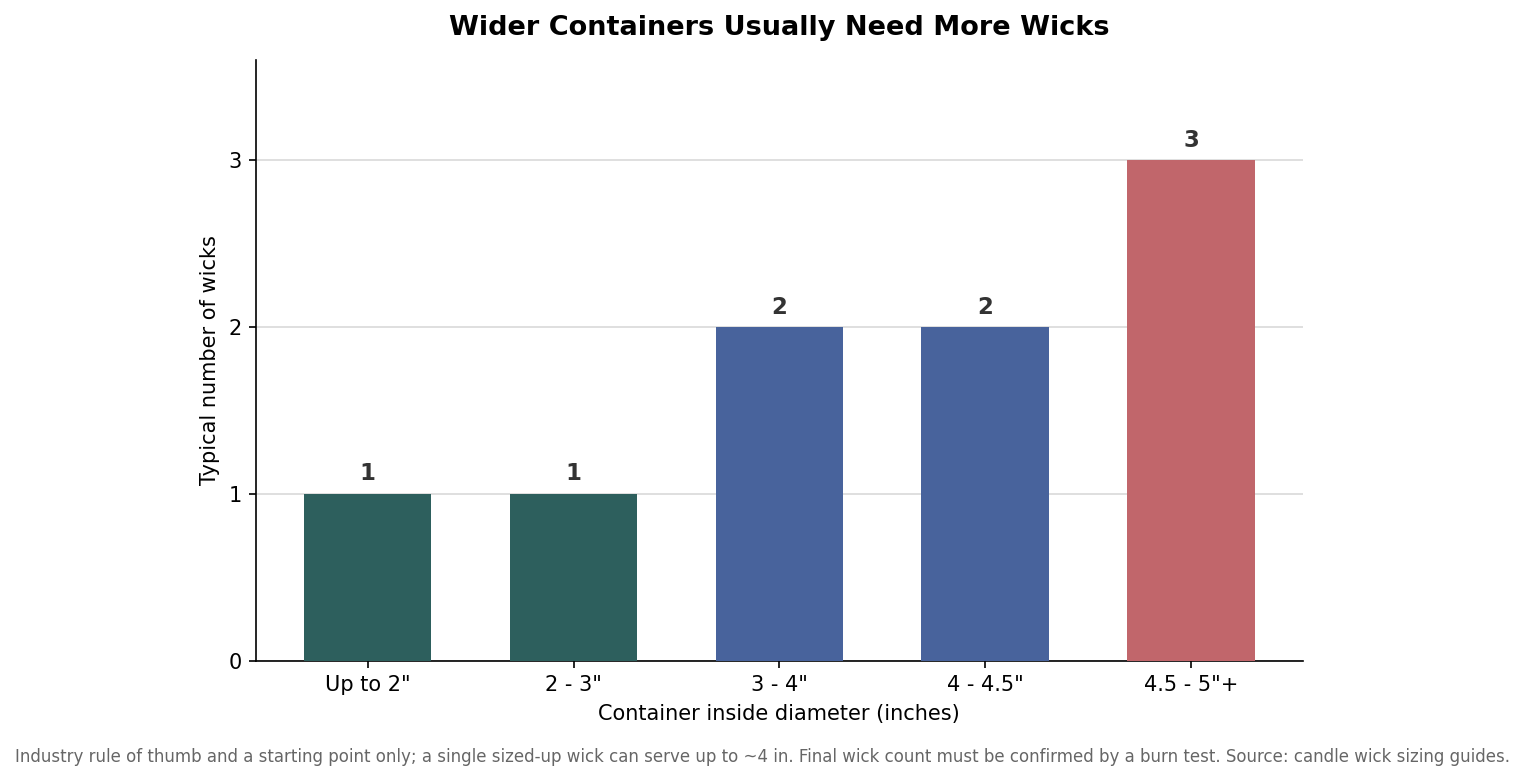
Treat any diameter-to-wick-count table as a beginning, not an answer. The figures above are the industry rule of thumb, and they get you into the right neighborhood, but they do not account for your specific wax or fragrance. A tall, narrow vessel behaves differently from a short, wide one of the same volume, and a container that narrows at the base changes how the pool forms. Use the diameter to pick a candidate wick and a candidate count, then let testing settle the final choice.
Adjust for the wax and the fragrance load
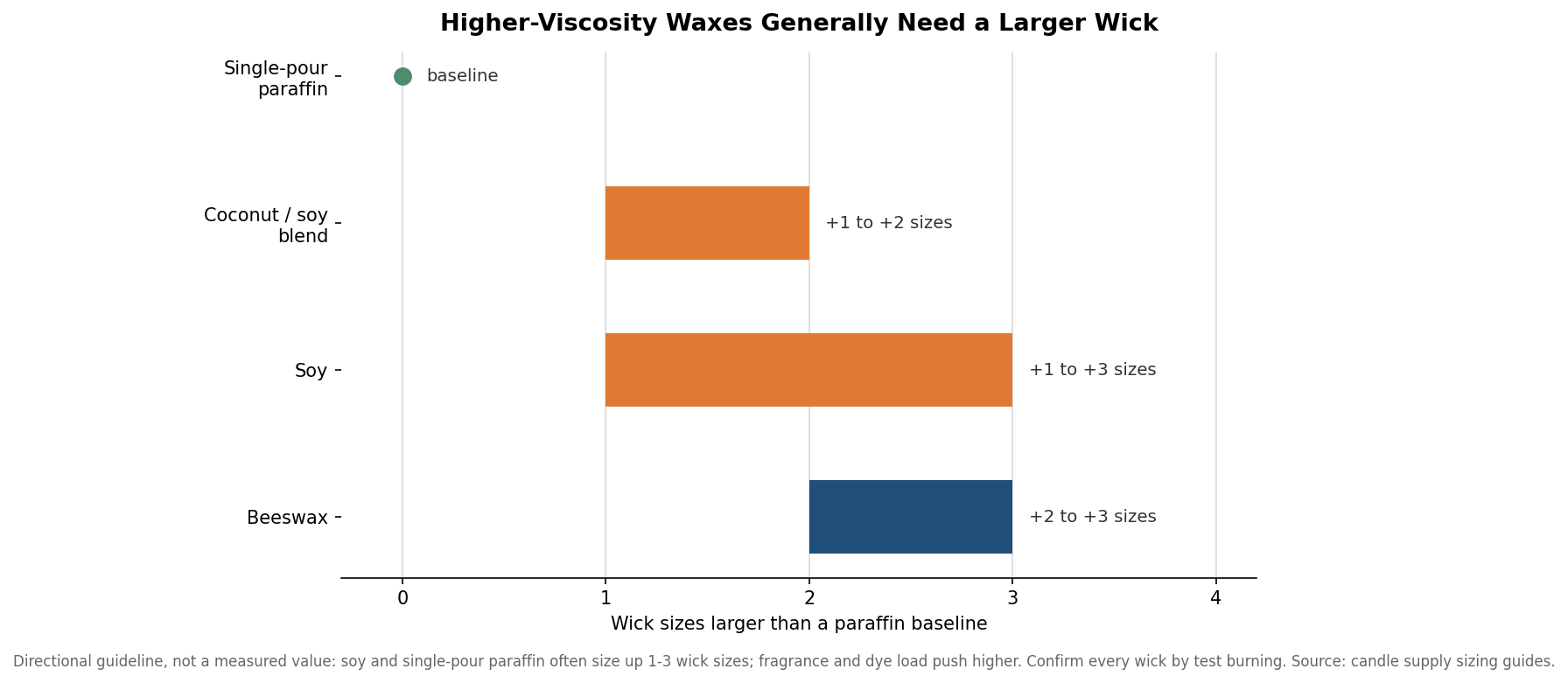
Heavier, higher-viscosity waxes need more wick. Paraffin, especially single-pour paraffin, melts readily, so it makes a convenient baseline. Natural waxes generally ask for a larger or hotter wick to reach the same full melt pool. Soy and single-pour paraffin often need to move up one to three wick sizes from a starting recommendation, and dense beeswax typically needs more still. Coconut and coconut-soy blends sit in between, softer and easier to melt than soy but still usually a step up from paraffin.
Fragrance and dye push in the same direction. A high fragrance load thickens the wax and makes it harder to burn, so a candle at eight or ten percent fragrance frequently needs a larger wick than the same wax unscented. Dye, particularly darker colors, can also require sizing up. The practical rule is to size the wick to the finished formula, not to the bare wax, because the additives are part of what the flame has to work through. When you change a fragrance or raise the load, revisit the wick rather than assuming the old choice still holds.
Choosing a wick series: cotton, cored, and wood
Wick families differ in how they stand up and how they burn. Flat-braided cotton wicks curl slightly as they burn, which helps them self-trim and reduces carbon buildup; they are a dependable default for soy and paraffin containers. Cored cotton wicks, sold in series such as ECO, CD, HTP, and LX, use a paper or cotton filament to hold the wick upright and shape the burn, and each series has its own personality across different waxes, which is why makers often test two series side by side before choosing. Wooden wicks burn with a low horizontal flame and a characteristic crackle, and they perform in paraffin, soy, and palm, but they are sized by width and thickness rather than by the cotton numbering and need their own testing. Zinc-core wicks stand very straight and resist drowning, but they tend to mushroom more and are less favored where a clean flame is the priority.
There is no universally best series. The sensible approach is to shortlist one or two series appropriate to your wax, then test specific sizes within them. A wick that is excellent in coconut wax may misbehave in beeswax, and the only way to know is to burn it.
The burn test is the real specification
Every wick choice is provisional until a test burn confirms it. The core metric is simple: on the first burn, the melt pool should reach the container wall within about two to four hours. If it does not, and instead leaves a ring of unmelted wax up the sides, the wick is too small and the candle will tunnel for the rest of its life. If the pool forms very fast and deep, with a tall flickering flame, soot, or a mushrooming wick tip, the wick is too large. The goal is a full, even pool that reaches the edge without the flame becoming aggressive.
Run the test the way a customer will burn the candle. Trim the wick to a quarter inch before lighting, burn in a draft-free spot, and keep individual burns to no more than about four hours, which is also standard safe-use guidance. Watch across several burns, not just the first, because problems like carbon buildup and an off-center pool often show up on the second or third session. Note the melt pool time, the flame height, the amount of soot, and how the vessel looks afterward. Only when a wick passes that sequence in the finished formula and the intended container should it go into a production run. Specifying a wick on paper gets you a strong candidate; the burn test is what turns it into the right answer.